
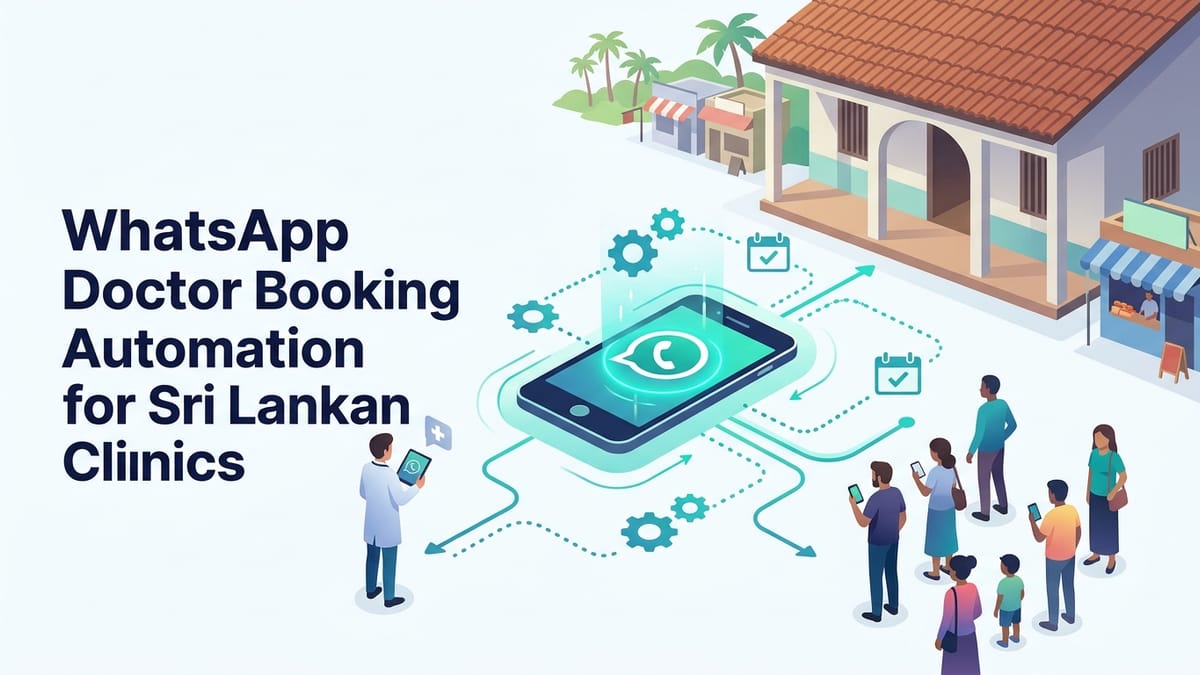
Executive Summary: Transforming Sri Lanka's Doctor Channelling Bottlenecks\n\nIn Sri Lanka, private healthcare access is driven by doctor channelling. Every day, tens of thousands of patients schedule visits with specialist consultants, general practitioners, pediatricians, and dental clinics across Colombo, Kandy, Galle, Negombo, and Jaffna. Yet, the patient journey remains plagued by friction: overwhelmed clinic reception lines, costly 225-type premium IVR phone calls, delayed confirmation SMS notifications, and unpredictable doctor arrival hours resulting from government hospital service commitments.\n\nDeploying doctor channelling automation through the official WhatsApp Business Platform (API) eliminates these operational logjams. With over 8 million active WhatsApp users in Sri Lanka, conversational automation shifts appointment discovery, slot booking, automated payments, and real-time token tracking into an intuitive, trilingual interface. For private medical practices, polyclinics, and diagnostic centers, adopting a dedicated healthcare bot in Sri Lanka drastically cuts administrative overhead, slashes patient no-show rates from 25% down to under 5%, and provides patients with dependable, stress-free access to care.\n\n---\n\n## 1. The Bottleneck in Sri Lankan Doctor Channelling and Patient Experience\n\nTraditional channelling mechanisms in Sri Lanka were built for a desktop-first or voice-first era. In practice, they create high operational overhead for healthcare operators and notable frustration for patients:\n\n* Overloaded Front Desks: A typical multi-specialty medical center in Colombo 03 or Jaffna town receives hundreds of phone calls every morning. Front-desk receptionists spend 70% of their bandwidth repeating basic information: doctor schedules, room charges, channelling fees, and estimated arrival times.\n* The Cost of Inflexible Channelling: Aggregated channelling portals and telco-operated IVR hotlines levy non-trivial service charges on patients, while clinics surrender patient communication ownership to third parties.\n* Peak-Hour Abandonment: Working professionals in Kandy or Negombo often give up when trying to book consultations during busy morning desk hours, directly eroding clinic revenue.\n* The 'Late Consultant' Dilemma: Because Sri Lankan specialist consultants often balance morning duties at state teaching hospitals before their private evening sessions, schedule shifts are frequent. Standard SMS alerts are one-way and impersonal, leaving waiting rooms crowded with anxious patients.\n\nImplementing a direct hospital WhatsApp channel bypasses these systemic challenges. Patients initiate a session directly from a clinic website, Google Business Profile, or print flyer, completing their booking in less than 60 seconds without installing another mobile app.\n\n---\n\n## 2. Architecture of an Automated WhatsApp Healthcare Bot\n\nMoving from a basic WhatsApp Business mobile application to enterprise-grade clinic appointment WhatsApp automation requires an integrated technological architecture:\n\n\n[Patient Device (WhatsApp)]\n │\n ▼\n[Meta WhatsApp Cloud API Gateway]\n │ Webhook (HTTPS POST / JSON)\n ▼\n[Backend Orchestration Engine (Node.js / Python)]\n ├── [Trilingual Natural Language Processor (EN/SIN/TAM)]\n ├── [Clinic Management System / EHR Database]\n └── [Payment Gateway Integration (LankaPay / PayHere)]\n\n\n### Key Architectural Components\n\n1. Meta WhatsApp Cloud API: Provides enterprise throughput, multi-agent session handoffs, interactive UI components (List Pickers, Quick Reply buttons), and programmatic template triggers.\n2. Trilingual Orchestration Engine: Patients can switch instantly between Sinhala, Tamil, and English. The system processes conversational inputs (e.g., 'Book ENT Dr. Perera for Saturday morning' or 'யாழ்ப்பாணத்தில் கண் மருத்துவர் பதிவு செய்ய வேண்டும்').\n3. Clinic Management System (CMS) & EHR Sync: The booking bot interfaces directly with the clinic's internal calendar or Electronic Health Record (EHR) system via RESTful APIs, preventing double bookings by locking slots in real time.\n4. Fintech Payment Rail Integration: Seamlessly triggers localized payment requests using secure checkout webviews supporting LankaPay, direct bank cards, and local mobile wallets.\n\n---\n\n## 3. Eliminating No-Shows: Automated Reminders, Live Queue Tracking, and Rescheduling\n\nPatient no-shows drain operational margins and block critical healthcare access for other patients. In Sri Lanka's consultation model, an absent patient leaves a vacant slot that cannot be recovered on the day of the clinic.\n\n### Interactive Pre-Appointment Alerts\nInstead of passive text messages, an automated healthcare bot dispatches interactive reminders at 24-hour and 3-hour milestones:\n\n* Interactive Confirmation: The message presents two interactive buttons: Confirm Attendance and Reschedule / Cancel.\n* Dynamic Slot Re-allocation: If a patient taps Cancel, the system releases that specific token back into the live inventory immediately, notifying waitlisted patients automatically.\n\n### Real-Time Live Token Updates\nOne of the most persistent complaints in private Sri Lankan healthcare is waiting hours in crowded waiting rooms because a doctor's shift was delayed. WhatsApp automation transforms this dynamic:\n\n* When the consultant checks in at the clinic, the automation sends a broadcast template: 'Dr. Wickramasinghe has arrived at Polyclinic Kandy. Current Token Serving: 01. Your Token: 14. Estimated consultation time: 6:45 PM.'\n* Patients track live token progression in real time via quick WhatsApp commands (/token_status), allowing them to arrive precisely when their consultation is imminent, preventing overcrowded waiting lobbies.\n\n---\n\n## 4. Compliance, Patient Privacy, and Payment Gateway Integration in Sri Lanka\n\nDeploying conversational healthcare systems requires adherence to regulatory standards, data sovereignty guidelines, and financial security requirements.\n\n### Compliance with the Personal Data Protection Act (PDPA)\nSri Lanka's Personal Data Protection Act, No. 9 of 2022 imposes stringent requirements on data controllers and processors regarding medical records and identifiable patient data:\n\n* Zero PHI on WhatsApp: WhatsApp is used for channelling, scheduling, token dispatch, and transaction coordination. Deep Protected Health Information (PHI)—such as blood test reports, historical clinical notes, and biopsy diagnoses—should not be exposed directly in plain conversation logs without two-factor authentication or expiring secure download links.\n* Consent Management: Explicit opt-in prompts are embedded at the start of every chat flow, ensuring patients consent to receiving reminders and administrative notifications.\n* Data Residency: Core databases storing patient records, phone numbers, and booking histories must adhere to secure cryptographic standards with regional backup controls.\n\n### Local Payment Integration\nMany Sri Lankan patients prefer reserving tokens without upfront payments, while private hospitals require full deposits to secure high-demand consultants. WhatsApp conversational workflows accommodate both options:\n\n* LankaPay IPG / PayHere Integration: The bot generates an ephemeral, PCI-compliant webview link. Once payment is confirmed by the payment gateway webhook, the bot instantly renders a digital PDF token directly in the chat with a scannable QR code.\n* Cash-at-Counter Mode: For walk-in friendly clinics, the bot reserves the token on conditional hold with an automatic expiration counter (e.g., 'Please verify at the counter 20 minutes before your token window').\n\n---\n\n## 5. Real-World Implementation Blueprint: From Single Polyclinics to Multi-Branch Networks\n\nA successful WhatsApp channelling deployment requires structured change management, technical testing, and operational alignment.\n\n### Phase 1: Workflow Auditing and Doctor Schedule Mapping (Weeks 1-2)\n* Map doctor rosters across branches (e.g., Colombo Central vs. Negombo satellite branch).\n* Define appointment rules: slot durations, walk-in buffer allocations, emergency overrides, and pricing tiers.\n\n### Phase 2: Technical Integration & Trilingual Scripting (Weeks 3-4)\n* Configure the Meta WhatsApp Business API through a trusted Tech Partner.\n* Build conversational trees in English, Sinhala, and Tamil.\n* Integrate webhooks with the clinic's local database or Cloud CMS.\n\n### Phase 3: Pilot Testing and Staff Training (Week 5)\n* Roll out the bot internally to reception and triage teams in Jaffna or Colombo.\n* Train receptionists to initiate WhatsApp session handoffs using unified team inboxes when human consultation is required.\n\n### Phase 4: Public Launch and Patient Onboarding (Week 6+)\n* Print dynamic QR codes on clinic receipts, appointment cards, and waiting-room signage ('Scan here to book your next appointment instantly').\n* Deploy click-to-WhatsApp ads on Facebook and Instagram targeting localized catchments (e.g., within a 10km radius of Galle or Kandy city limits).\n\n---\n\n## Strategic Insights: ROI, Metrics, and Realistic Economics\n\nCalculating the tangible return on investment (ROI) clarifies the impact of switching from call-center channelling to automated WhatsApp messaging:\n\n| Performance Metric | Traditional Call Center / Desk | WhatsApp Automated Booking | Strategic Advantage |\n| :--- | :--- | :--- | :--- |\n| Cost per Booking | LKR 80 - 150 (Staff time, telco charges) | LKR 5 - 15 (Meta utility tier + cloud host) | Up to 85% reduction in booking handling cost |\n| Booking Turnaround Time | 4 to 8 minutes per phone call | Under 60 seconds self-service | 4x faster throughput |\n| Patient No-Show Rate | 18% - 25% average | Less than 6% with interactive reminders | Recovers lost clinic revenue |\n| Booking Window Availability | Clinic operating hours (8 AM - 6 PM) | 24/7/365 availability | Captures evening & late-night bookings |\n| Language Inclusivity | Dependent on desk staff availability | Native Sinhala, Tamil, English auto-select | Expanded demographic reach across provinces |\n\nClinics processing just 1,500 channelling sessions a month routinely recover hundreds of staff-hours while creating a reliable private patient database for repeat preventative checkups and wellness campaigns.\n\n---\n\n## Frequently Asked Questions (FAQ)\n\n### 1. How does the WhatsApp bot manage doctors arriving late due to emergency government hospital duties?\nWhen a consultant notifies the clinic management team of a schedule change or delay, the front desk updates the central dashboard. The system then automatically triggers an instant, transactional WhatsApp broadcast to all patients holding tokens for that session. Rather than sitting in a crowded waiting hall for hours, patients receive exact adjusted arrival targets, protecting the clinic's reputation for patient care.\n\n### 2. Can the healthcare bot integrate with our existing clinic management software, or do we have to replace it?\nYou do not need to replace your existing systems. The automated WhatsApp engine connects to your current database, clinic management system, or EHR via modern web APIs, SQL connectors, or dedicated webhooks. If your clinic relies on spreadsheet-based scheduling or legacy local desktop software, custom secure middleware can bridge the data to the WhatsApp Cloud API seamlessly.\n\n### 3. Does an automated WhatsApp channelling system comply with Sri Lanka's Personal Data Protection Act (PDPA)?\nYes, provided the integration architecture is designed with compliance in mind. Personal identifiable information and sensitive clinical records should remain encrypted within secure, compliant databases. WhatsApp functions as an encrypted transport mechanism for appointments, confirmation tokens, reminders, and payment receipts. Incorporating transparent privacy notices, opt-in confirmations, and zero-PHI transfer practices ensures adherence to Sri Lanka's PDPA statutory regulations.\n\n---\n\n## Elevate Your Healthcare Patient Experience with SafeNet Creations\n\nModernizing patient interactions requires deep architectural precision, regulatory awareness, and a clear understanding of Sri Lanka's local healthcare ecosystem. SafeNet Creations bridges world-class enterprise software engineering with real-world local business strategy.\n\nWith our core engineering base in Jaffna and strategic coordination in Colombo, SafeNet Creations builds and deploys bespoke doctor channelling automation, custom healthcare bots, and enterprise web solutions tailored for private hospitals, polyclinics, specialized practices, and diagnostic networks across Sri Lanka. Whether you are seeking to reduce reception overhead, eliminate appointment no-shows, or deliver trilingual digital booking experiences, our technical teams design secure, scalable, and revenue-driving systems.\n\nReady to modernize your clinic's booking workflows? Partner with SafeNet Creations to launch your customized, automated WhatsApp channelling platform.
Explore Related SafeNet Services in Sri Lanka
- Website Design & Development Company in Sri Lanka — Fixed-scope Next.js websites from LKR 59,900
- AI Voice Agents, AI Receptionists & Chatbots in Sri Lanka — English, Tamil & Sinhala conversational AI
- WhatsApp Business Automation & Bot Development in Sri Lanka — Official WhatsApp API, CRM integration & booking flows
- SEO Company & SEO Services in Sri Lanka — Technical SEO, Search Console & local search visibility
- Software Development Company in Sri Lanka — Custom dashboards, CRMs & web portals
- Web Design, WhatsApp & Digital Marketing Prices in Sri Lanka (LKR) — Full transparent pricing catalogue