
Executive Summary
For digital media conglomerates, banking institutions, and hospitality leaders across Sri Lanka, legacy monolithic CMS setups like traditional WordPress or Drupal are hitting hard architectural walls. Sluggish page loads over local mobile connections, database lockups during breaking news spikes, security vulnerabilities, and cumbersome multi-language localization (Sinhala, Tamil, English) severely restrict digital transformation. Transitioning to a modern decoupled CMS powered by headless architecture unlocks sub-second page performance, omnichannel content distribution across web and mobile apps, and unbreachable frontend security. This comprehensive guide outlines how enterprise organizations from Colombo to Jaffna can evaluate, architect, and deploy headless CMS solutions to outpace regional competition.
1. The Monolithic Trap: Why Traditional CMSs Fail Modern Sri Lankan Portals
For nearly two decades, traditional all-in-one content management systems powered the bulk of Sri Lanka's web ecosystem. In this traditional model, the content database, administration interface, and user-facing presentation layer (the HTML templates rendered via PHP) are tightly coupled together on a single server cluster.
While this architecture served small businesses adequately, it collapses under modern enterprise demands:
- Catastrophic Traffic Spikes: When breaking news breaks—whether a national budget announcement or an election update—Sri Lankan newsrooms frequently witness traffic surging by 500% within minutes. In a monolithic setup, every visitor request executes dynamic PHP scripts and database queries against MySQL. The result is familiar to anyone browsing local portals during peak events: timeout errors and crashing servers.
- Mobile Latency Over Islandwide Networks: Outside tier-one fiber infrastructure in Colombo, users in regions such as Jaffna, Kandy, Galle, and Batticaloa access services primarily via mobile 4G connections. Monolithic themes often load megabytes of bloated JavaScript libraries, inline styles, and uncompressed plugin assets, pushing Largest Contentful Paint (LCP) past 5 to 7 seconds.
- Surface-Area Vulnerabilities: Tight integration between administrative endpoints (
/wp-admin) and public-facing frontends exposes organizations to SQL injections, plugin exploits, and automated brute-force attacks.
Modern digital leaders are replacing these brittle legacy systems through enterprise-grade Web Design & Website Development in Sri Lanka that splits content management completely away from presentation.
2. Demystifying Decoupled CMS: The Architecture Behind Next.js and APIs
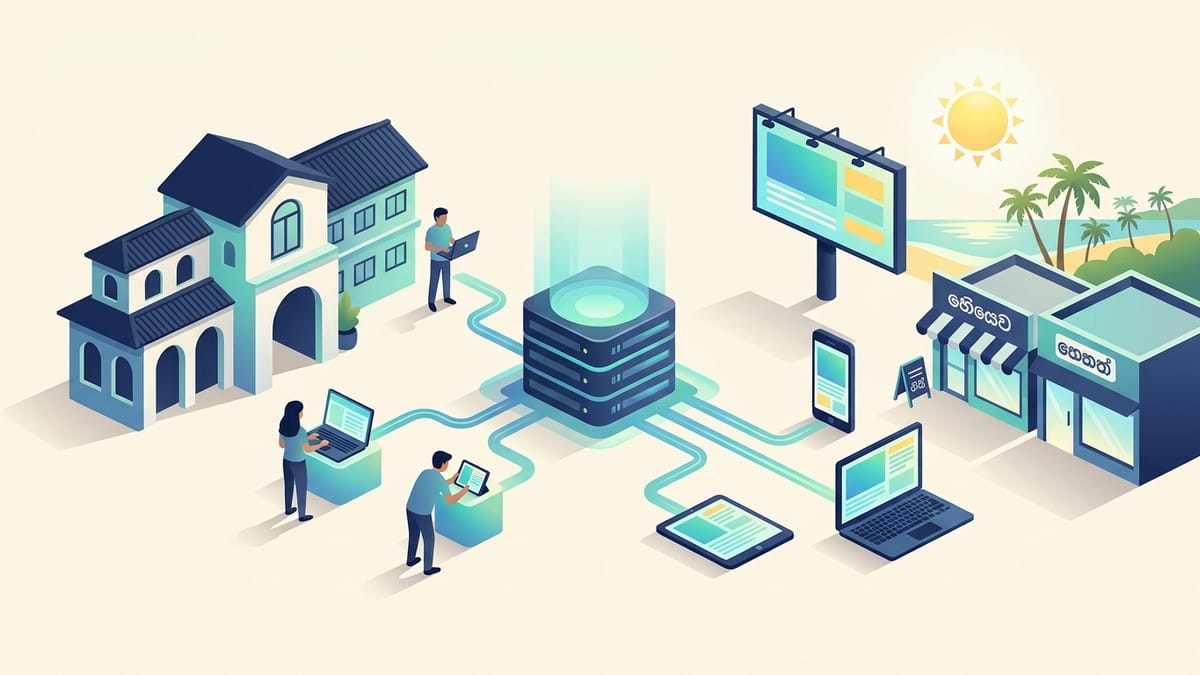
A decoupled CMS (commonly called a headless CMS) strips away the frontend presentation layer entirely. Instead of generating static HTML pages directly from templates, a headless system manages raw content items through an intuitive editing dashboard and serves that content strictly via structured APIs (REST or GraphQL).
[ Content Editors ]
       │
       ▼
[ Headless CMS Engine ] (Strapi / Sanity / Contentful)
       │  (GraphQL / REST APIs)
       ▼
[ Edge Delivery Layer ] (Vercel / Cloudflare Edge Workers)
       │
 ┌─────┴────────────────┬───────────────────┐
 ▼                      ▼                   ▼
[ Next.js Web App ]   [ Mobile Apps ]   [ Digital Signage / WhatsApp ]
(Sub-second SSG/ISR)  (iOS & Android)   (Chatbots & In-store Kiosks)
The Role of Next.js Headless Frontends
By pairing a headless CMS with modern frameworks like Next.js headless, Sri Lankan organizations achieve the holy grail of web architecture: Incremental Static Regeneration (ISR) and static site generation (SSG).
- Pre-Rendered at Build Time: Pages are compiled into lightweight HTML and JSON files before visitors even arrive.
- Edge Caching Near Sri Lanka: These static assets are distributed across globally synchronized Content Delivery Networks (CDNs) with point-of-presence (PoP) edge nodes in Singapore, India, and Sri Lanka.
- Near-Zero Database Work: When a reader in Negombo or Galle accesses an article or product page, the CDN serves the cached file instantly within 80 to 200 milliseconds without querying your backend database.
- Dynamic Revalidation on Demand: When an editor in Colombo edits an article, a webhook triggers Next.js to rebuild only that specific page in the background, updating readers instantly without full system redeployments.
3. Strapi vs Sanity: Choosing the Right Engine for Colombo & Jaffna Enterprises
When deploying Headless CMS Sri Lanka initiatives, engineering teams typically weigh two dominant industry standards: self-hosted open-source platforms and cloud-native managed SaaS platforms. In the local landscape, the primary contest is Strapi Sanity Colombo deployments.
| Architectural Vector | Strapi (Self-Hosted / Open-Source) | Sanity.io (Cloud-Native / Composable) |
|---|---|---|
| Data Sovereignty | 100% Control: Can be hosted on local cloud accounts (AWS Mumbai, DigitalOcean, or private data centers in Sri Lanka) satisfying Central Bank / banking regulatory guidelines. | Managed Cloud: Data is stored in secure international multi-tenant clouds; requires compliance review for strictly regulated domestic data. |
| Customizability | Node.js backend; fully extensible schema, custom controller overrides, and fine-grained database indexing. | Sanity Studio (React-based dashboard); highly tailored collaborative interfaces and flexible real-time schemas. |
| Pricing Model | Community edition is open source; licensing fees scale with administrative users rather than API volume. | Usage-based pricing on API reads/writes and assets; predictable tiering for agile development teams. |
| Best Suited For | Large conglomerates, financial services, and media groups requiring dedicated infrastructure and private VPC connectivity. | Fast-moving e-commerce brands, high-growth startups, and boutique tourism operators prioritizing rapid release cycles. |
For companies requiring custom business logic, back-office API integrations, or bespoke internal workflows, partnering with an established Software Development Company in Sri Lanka ensures that either platform is configured with rigorous enterprise data models from day one.
4. Solving Islandwide Challenges: Trilingual Content, Weak Bandwidth, and Core Web Vitals
Operating an enterprise digital presence in Sri Lanka introduces unique functional hurdles that generic off-the-shelf templates rarely solve effectively.
Trilingual Publishing Workflows (Sinhala, Tamil, English)
Sri Lankan media houses and governmental agencies must publish unified campaigns simultaneously across all three national languages. In traditional monolithic environments, multi-language plugins create duplicate database rows, messy permalink routing, and synchronization bugs.
In a headless environment, internationalization (i18n) is an atomic data attribute. A single content object holds synchronized fields for:
title_en,title_si,title_taslug_en,slug_si,slug_ta- Localized rich-text blocks and metadata
Editorial teams in Jaffna can update the Tamil edition of an economic report while translators in Colombo finalize the Sinhala version, with Next.js serving localized routes (/ta/..., /si/...) flawlessly without cross-plugin conflicts.
Core Web Vitals and Search Dominance
Google evaluates site speed and stability heavily through Core Web Vitals (CWV). Monolithic portals regularly flunk Cumulative Layout Shift (CLS) and Interaction to Next Paint (INP) due to unoptimized third-party tracking scripts and render-blocking styles. Moving to a decoupled CMS structure and pre-rendering frontends yields straight 90+ Lighthouse performance scores, creating a distinct competitive edge reinforced by specialized SEO Company & SEO Services in Sri Lanka.
5. Strategic ROI: Development Velocity, Security Hardening, and Scalability
Transitioning to a headless architecture is fundamentally an economic decision for enterprise leadership. The return on investment (ROI) materializes across three core operational dimensions:
1. Developer Productivity and Tech Agility
In legacy setups, changing your website design requires rewriting theme code tangled deep inside CMS template engines. In a headless paradigm, frontends and backends are separated by an API contract. Your design engineering team can adopt modern component-driven libraries (Tailwind CSS, React, TypeScript) and iterate UI features without fearing that an update will corrupt the database schema.
2. Bulletproof Security Profiles
Because your public visitors only ever interact with static files or serverless edge functions on a CDN, your CMS database and administrative panel remain sequestered behind strict private subnets, firewall rules, and zero-trust SSO authentication. The entire attack surface of automated web scrapes, zero-day plugin exploits, and common DDoS attempts against administrative endpoints drops to near zero.
3. Omnichannel Asset Syndication
Content created once in your headless dashboard can simultaneously feed:
- High-speed corporate websites
- Native iOS and Android passenger/customer apps
- Interactive in-branch digital signage in Colombo branches
- Automated conversational interfaces and WhatsApp notification pipelines
Frequently Asked Questions
Is a headless CMS overkill for mid-sized Sri Lankan organizations?
Not anymore. Historically, decoupled systems required enterprise-scale engineering teams. However, modern managed solutions like Sanity and open-source frameworks like Strapi have dramatically lowered integration barriers. Any organization managing high content volume, multi-lingual requirements, or dependent on mobile conversion rates across Sri Lanka's mobile network landscape will realize tangible speed, SEO, and uptime benefits within months.
How does a decoupled architecture specifically improve search engine optimization (SEO)?
Traditional CMS setups often rely on heavy plugins that inject duplicate code, slow down server response times (TTFB), and degrade mobile rendering. A headless frontend running on Next.js allows fine-grained programmatic control over structured schema markup, OpenGraph metadata, and automatic sitemap generation, all while maintaining near-instantaneous page-load times that directly influence Google's ranking algorithm.
Can existing editorial teams adapt easily to Strapi or Sanity?
Yes. Both Strapi and Sanity provide intuitive visual authoring environments that rival the ease of legacy editors. Non-technical journalists, copywriters, and content managers can write, format media, schedule posts, and manage localization without writing code. Previews can be generated instantly on private staging links before live deployment.
Engineering Your Headless Future with SafeNet Creations
The digital landscape across Sri Lanka is shifting rapidly toward performance-first, multi-device experiences. Whether you operate a high-volume media house in Colombo, an expanding retail chain in Kandy, or an international hospitality brand spanning Galle and Jaffna, legacy content architectures will inevitably bottleneck your growth.
At SafeNet Creations, our senior software architects, frontend engineers, and cloud infrastructure specialists bridge technical precision with commercial realities. We design, build, and deploy high-performance headless CMS and Next.js architectures built for zero downtime, multi-lingual precision, and conversion velocity.
Ready to modernize your digital infrastructure? Consult with SafeNet Creations today to architect your migration path to modern headless web performance.